Agent-Native Shift-Left CI for High-Velocity Solo Engineering
High Output Changes the Economics of Quality
One of the first things that breaks in agent-native development is any quality model that assumes commits arrive at a normal human pace.
That is not a criticism of agents. It is a consequence of what happens when implementation cost collapses.
When one experienced engineer can direct multiple workstreams in parallel, the system starts producing changes fast enough that old feedback loops become too slow, too expensive, or too easy to ignore.
That is why I ended up building a much more aggressive shift-left CI model inside Business OS.
The goal was not to imitate a big-company DevOps team. The goal was much simpler:
- keep feedback close to the change
- keep cloud CI costs near zero
- make frequent agent-generated commits survivable
- preserve a human decision gate before live deployment
- and stop broken or obviously weak work from accumulating faster than I could reason about it
The result has been useful. It has also been imperfect in ways that are worth being honest about.
What the System Actually Looks Like
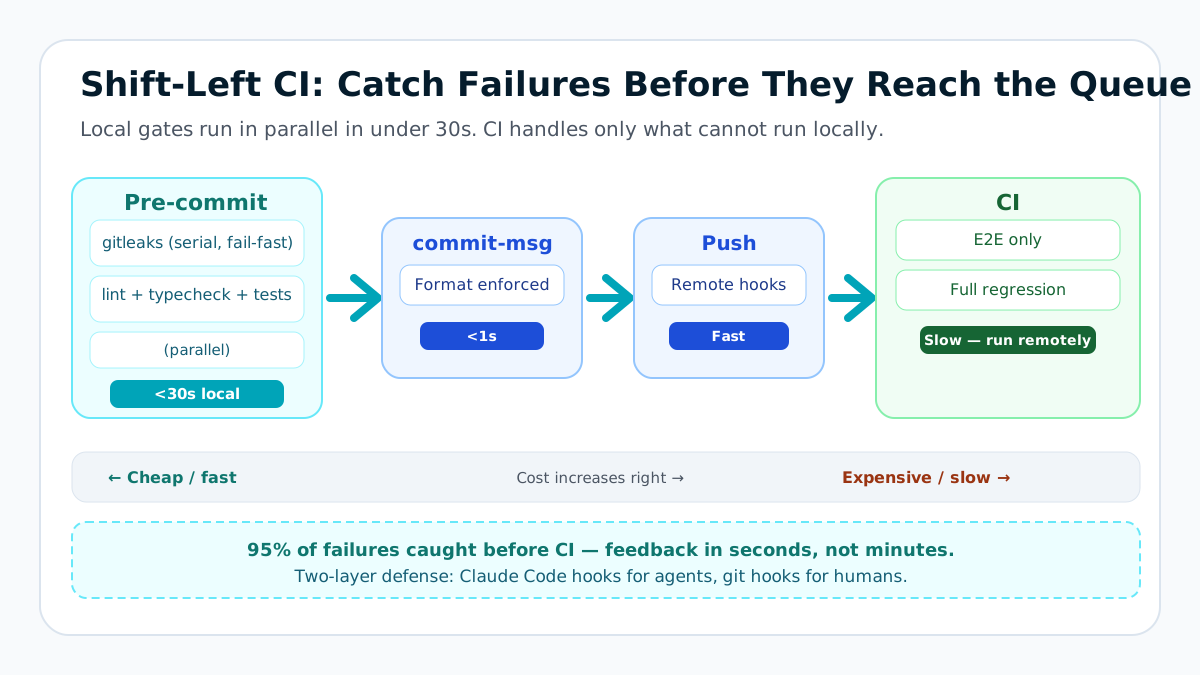
The current setup combines four layers:
- Commit-msg enforcement
- Pre-commit local quality gates
- Pre-push local browser verification
- GitHub Actions workflows running on a self-hosted macOS runner
At a high level, the operating model looks like this:
git commit
  → route-tree freshness check
  → secret scan
  → lint + typecheck + isolated tests in parallel

git push
  → local Playwright smoke gate

manual decision
  → trigger staging deploy workflow

GitHub Actions on self-hosted macOS runner
  → pre-deploy tests
  → deploy API
  → deploy Web
  → staging cloud E2E

release tag
  → production deploy
  → production smoke test
  → rollback path if smoke fails
That is the broad shape. But the details are where the interesting lessons are.
The Parts That Have Worked Well
1. Worktree-wide hooks matter more than most people think
One of the most useful details in the setup is not glamorous at all.
The hooks are installed via an absolute shared core.hooksPath pointing at the main repo’s .githooks/ directory.
That means all worktrees inherit the same hooks, including agent worktrees and older branches that predate the hook changes.
This solved a real problem.
In an agent-heavy workflow, it is common to have multiple worktrees active at once. If hook installation is branch-local, one stale branch can silently bypass the protections and land low-quality changes.
That sounds like a small implementation detail. It is not. It is one of the difference-makers between “we have hooks” and “the hooks actually shape the system.”
2. Parallel local checks are the right default for high-frequency commits
The pre-commit hook is directionally strong. It does two cheap serial checks first:
- route-tree freshness
- secret scanning via
gitleaks
Then it runs the heavier gates in parallel:
bun run lintbun run typecheckbun run test
The measured timings documented in the repo are roughly:
- lint: ~14s
- typecheck: ~52s
- isolated test run: ~5s
- total wall time: ~52-60s, because the checks run concurrently
That is exactly the kind of tradeoff I think makes sense for agent-native work.
If commits are frequent, serial quality gates become friction fast. Parallel gates let you keep the feedback perimeter reasonably strong without turning every commit into a multi-minute interruption.
3. Dedicated test ports reduce a huge amount of friction
The Playwright config uses dedicated test ports:
- web:
:5174 - api:
:3002
instead of the ordinary dev ports:
- web:
:5173 - api:
:3001
This is a deceptively good idea.
It means browser tests can run without tearing down or hijacking the normal dev server. For solo engineering, that matters a lot. You do not want every verification pass to fight the environment you are actively using to build.
This is one of the cleaner lessons from the whole system:
if shift-left CI feels like it is constantly interrupting development, people will route around it.
Dedicated ports made the local verification layer easier to live with.
4. The self-hosted runner changes the cost model completely
All six workflow files in the repo currently target runs-on: [self-hosted, macOS], and the current workflow surface contains 14 self-hosted jobs.
That means:
- staging deploy validation
- release gating
- production deploys
- production smoke
- release automation
- Claude automation workflows
all depend on the same local runner setup.
The upside is obvious:
- $0 GitHub Actions minutes
- same hardware every time
- easy access to local tooling
- no waiting for cloud runner provisioning
- a tighter loop between local engineering and workflow orchestration
For a high-velocity solo setup, that is a meaningful win.
When you are landing frequent changes, cloud CI billing and queue overhead stop being abstract concerns pretty quickly.
5. Keeping a human gate between push and deploy was the right call
One of the best choices in the system is that a push does not automatically mean “deploy staging now.”
There is still a human decision gate.
That matters because in an agent-native workflow, many commits are valid local progress but not yet the right integration point for a staging wave. If every push automatically deployed, staging would become noisy, expensive, and harder to reason about.
So the sequence became:
- local commit gate
- local push gate
- human decision
- staging deploy + cloud verification
I think that is a better model than pretending every successful local commit is deploy-ready.
In a high-velocity agent-native workflow, the right question is not “how do we automate every step?” It is “where should the automation end and where should deliberate human integration begin?”
The Honest Metrics
There are a few concrete numbers that help describe what this system has actually provided.
Current pipeline metrics from the repo
- Pre-commit parallel gate: roughly 52-60s wall time
- Pre-push smoke gate: current hook runs 4 Playwright smoke tests
- Manual staging deploy path: documented at roughly ~8 minutes end to end
- Workflow dependency: 6 workflow files and 14 jobs currently target the self-hosted macOS runner
- Testing surface audited: 659 test files in the March 10 repository-wide audit
Confidence metrics that temper the story
The critical March 10 audit graded the test suite C+. That matters.
Because the shift-left system improved gating, but it did not magically solve test confidence.
Repository-wide candidate findings from that audit included:
- 824 FC-B shape-only assertion hits across 212 files
- 224 FC-E empty-pass style hits across 46 files
- 595 conditional assertion patterns across 202 files
- 74 of 108 web route files lacking a dedicated colocated route test pair
- 5 of 72 API route files lacking a dedicated route test pair
- 2 of 79 API services lacking a dedicated service test pair
Those numbers are important because they stop the story from becoming self-congratulatory.
The system clearly improved the speed and regularity of feedback. But it did not make a green suite automatically mean strong proof.
Where the System Has Genuinely Helped
If I strip the story down to the actual benefits, I think they are these.
1. It reduced the cost of catching obvious regressions early
That is the basic shift-left promise, and it has largely held.
Simple problems are much less likely to travel all the way to staging now:
- route registration drift
- secret leakage
- lint/type errors
- broken local smoke flows
- basic test failures
That matters more in an agent-native environment because local error accumulation can happen very quickly.
2. It made frequent commits safer
The pre-commit and pre-push model means I can commit and push more aggressively without relying on memory alone to maintain quality.
That does not eliminate review. It reduces the number of obviously bad states that survive long enough to become harder problems.
3. It made deployment workflows financially cheap enough to use often
The self-hosted runner changes the economics.
A solo engineer can afford to lean on GitHub Actions orchestration more heavily when the runner cost is effectively the cost of the local machine already being used.
That is not just a budget win. It changes behaviour. More checks actually get used when they do not feel like they are burning cash every time.
4. It reinforced the idea that verification is part of implementation, not a later phase
This may be the most philosophical gain.
In the older model, it is easy to treat CI as something that happens after the work.
In a high-velocity agent-native model, that mindset breaks down. The system only remains coherent if verification sits much closer to the act of change.
This setup helped push the process in that direction.
Where the System Is Weaker Than It First Appears
This is the more important part.
1. The docs and the live gates have drifted
One of the clearest findings from the deep dive is that the written description of the pipeline and the current live behavior are not perfectly aligned.
Some docs still describe a heavier pre-push model involving:
- full
local-fullPlaywright coverage - coverage checks in parallel
- around 281 tests with 25 skipped
But the current live .githooks/pre-push is lighter.
It runs only the local smoke project:
- 4 tests
- and it skips entirely if the local API is not reachable on
:3002
That is a very important finding.
It does not mean the system is bad. It means the system evolved under real pressure and the docs did not fully keep up.
That kind of drift is exactly the sort of thing high-velocity teams have to treat as a first-class risk.
2. A self-hosted runner is also a single point of failure
The self-hosted runner saves money and keeps the loop close to home. It also means a surprising amount of automation depends on one machine being:
- online
- healthy
- authenticated
- correctly configured
- not asleep
- not overloaded
That is fine for a solo engineering system if you acknowledge it clearly. But it is not the same thing as resilient distributed CI.
The runner is not just a convenience. It is local infrastructure. And local infrastructure has failure modes.
3. Shift-left gates do not fix weak test contracts
This is probably the most important limitation.
Running a weak test earlier does not make it strong. It just makes the weak signal arrive sooner.
That is exactly what the C+ audit exposed.
The repo has a lot of tests. It also still contains too many tests that prove:
- something responded
- something rendered
- something truthy existed
- something had the right shape
instead of proving the intended contract precisely.
That is not a criticism of shift-left CI. It is a reminder of its real role.
Shift-left CI is a delivery and containment improvement. It is not a substitute for high-quality verification design.
4. Skip paths are necessary, but they are also loopholes
The system intentionally allows bypasses:
git commit --no-verifygit push --no-verify- selective environment-variable skips
I think that is the right design for a solo operator. Rigid systems that cannot be bypassed in emergencies eventually get disabled entirely.
But bypasses are still bypasses. They depend on discipline. So the protection is partly technical and partly behavioral.
5. The setup optimises for one person very well, but that does not mean it generalises cleanly
A lot of this works because it is designed around a specific reality:
- one primary engineer
- one main machine
- high repository familiarity
- strong local control
- willingness to own local infra complexity
That is a legitimate model. But it is not automatically the right model for a larger or more distributed team.
What I Would Distill as the Real Lessons
If I strip out the noise, the lessons I would actually keep are these.
1. Put cheap truth checks as close to the commit as possible
Secrets, route generation freshness, lint, typecheck, and isolated tests all belong very close to the act of change. That part is straightforward and worth keeping.
2. Parallelise quality gates whenever possible
Agent-native development creates enough commit frequency that serial quality gates become friction fast. Parallelism is not a luxury here. It is part of making the system usable.
3. Separate ordinary dev ports from test ports
This is one of the most transferable ideas in the whole setup. It reduces local friction more than people expect.
4. Keep a human integration gate before expensive or externally visible environments
Automation should push quality left. It should not erase judgement.
5. Treat CI documentation drift as a real engineering problem
One of the most honest lessons from this deep dive is that the quality system itself needs its own verification.
If the docs, setup scripts, and live hooks tell different stories, then the engineering organisation is already losing truth. That is especially dangerous in agent-native systems where the process changes quickly.
6. Do not confuse test volume with confidence
This is the lesson that matters most.
A fast, local, self-hosted, shift-left pipeline is valuable. But it does not matter nearly as much as people think if the tests themselves are still permissive or shape-only.
The biggest quality wins still come from stronger contracts, not just earlier execution.
Shift-left CI improves the speed of feedback. It does not automatically improve the truthfulness of the feedback. In high-velocity agent-native systems, that distinction becomes critical.
My Current View
I think the shift-left CI model in business-os-cloud has been a real net positive.
It made local feedback tighter. It made frequent commits safer. It made GitHub Actions orchestration effectively free. It created a much better fit between high-velocity agent-native delivery and the quality perimeter around it.
But I do not think the honest story is:
we built the perfect solo-engineering CI system.
The more honest story is:
we built a strong, practical, high-leverage shift-left system for a team of one, and then discovered that the next bottleneck was not whether the gates existed, but whether the things being gated were actually strong proofs.
That feels like the real lesson.
The first generation of agent-native quality systems is about moving checks earlier. The second generation is about making those checks worthy of trust.
Related Reading
- 60% of Our Tests Had Zero Signal: How We Discovered False Confidence provides the audit context for why these stricter quality gates became necessary.
- Building ESLint Rules to Prevent Tests That Lie shows one way we turned false-confidence patterns into enforceable pre-commit rules.
That is the part I think matters next.