The Hard Part of AI SaaS Isn’t the Agent. It’s the Boundary
Internal Capability and Product Capability Are Not the Same Thing
There is a stage a lot of AI products go through where the internal demos are genuinely impressive.
The team can show:
- context-rich conversations
- useful generation
- working tool calls
- elegant orchestration
- strong internal workflows
At that point it becomes tempting to think the product is close.
Often it is not.
Because the moment you try to turn an internal agent system into SaaS, the problem changes shape.
It stops being mostly about what the model can do and starts becoming mostly about boundaries.
By boundaries, I mean all the things that define where intelligence is allowed to operate, how trust is established, and what guarantees the product can honestly make.
That includes:
- authentication
- tenant isolation
- entitlements
- permissions
- billing state
- rate limiting
- runtime correctness
- event delivery guarantees
- supportability
- and clear separation between durable truth and process-local convenience
Those are not side concerns. They are the product.
An internal system can feel deceptively mature because the builders already carry the missing context in their heads. SaaS users do not inherit that context. They inherit your boundaries, your guarantees, and your failure modes.
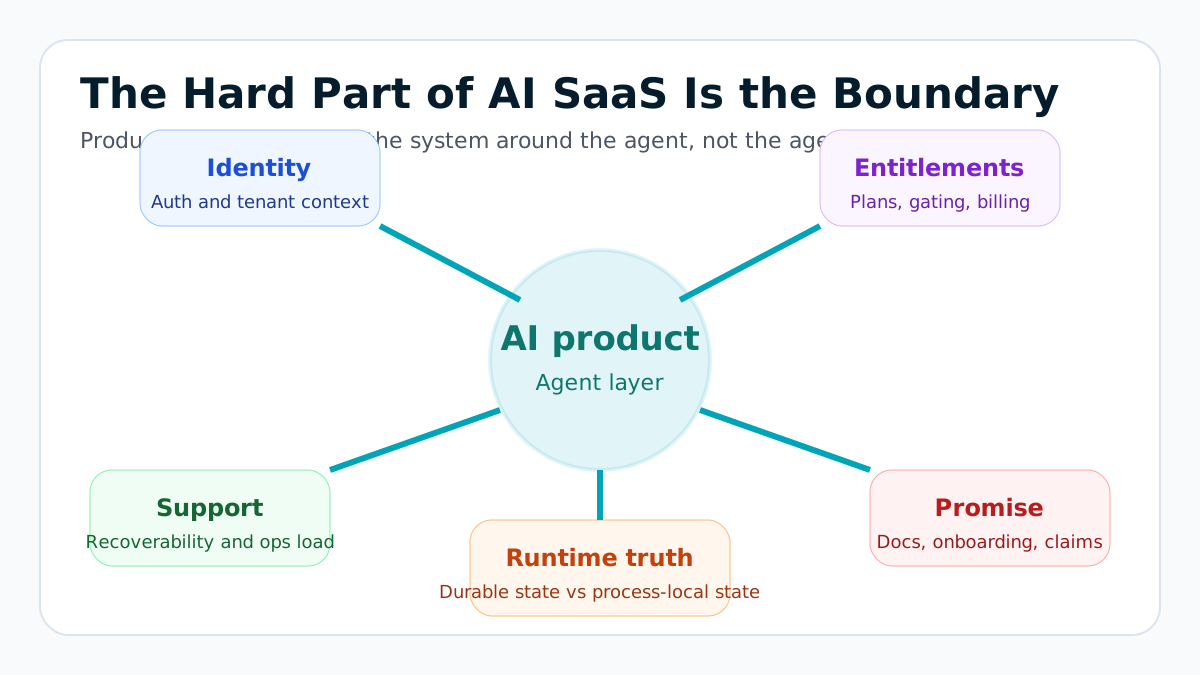
Why Internal Success Can Mislead Teams
An internal agent system usually benefits from hidden assumptions.
The people using it often already understand:
- the data model
- the edge cases
- the intended workflow
- the current limitations
- which caveats are real but undocumented
- and which breakages are acceptable because the team can manually recover
That makes a system feel much more product-ready than it actually is.
SaaS users do not inherit that context. They need the boundaries to be explicit and reliable.
They need to know:
- who is allowed to do what
- which plan includes which capability
- what happens when a background task fails
- what is guaranteed versus best effort
- what data belongs to which tenant
- how local and cloud components trust each other
- whether a result is authoritative or merely process-local
Those are boundary questions. Not prompt questions.
The Boundary Surface Is Where Trust Actually Lives
When people talk about trust in AI products, they often focus on answer quality. That matters. But operational trust in SaaS products lives elsewhere too.
Users trust a system when:
- access control is predictable
- tenant data does not leak
- plan limits behave as expected
- errors are intelligible
- long-running work does not disappear into ambiguous state
- and the product’s claims match the runtime’s real guarantees
If those things are weak, a surprisingly capable agent can still feel unsafe.
This is one of the reasons AI SaaS feels harder than many early builders expect. The most painful failures are often not “the model said something weird.” They are:
- the wrong thing was allowed
- the right thing was blocked
- the billing state and product state diverged
- the background job looked complete but was not durable
- the event stream implied guarantees the system did not actually support
- the docs sounded stronger than the runtime really was
That is boundary failure.
The Specific Boundary Problems That Matter Most
In practice, I think there are a handful of recurring categories.
| Boundary Type | What It Protects | What Breaks When It Is Weak |
|---|---|---|
| Identity and authorisation | who can do what | access ambiguity, unsafe actions, tenant confusion |
| Plan and entitlement | feature and billing truth | mismatched UI, broken gating, user distrust |
| Runtime truth | durable state vs ephemeral state | misleading status, replica inconsistency, retry ambiguity |
| Support boundary | what the team can realistically sustain | hidden ops load, recovery-by-tribal-knowledge |
| Documentation and promise | what the product claims | overstatement, launch drift, broken trust |
1. Identity and authorisation boundaries
Who is the user? Which tenant are they acting inside? What can they do? What can their device do? Which contexts should be public, tenant-exempt, device-bound, or role-gated?
If those questions are fuzzy, the product is unstable even if the agent layer is excellent.
2. Plan and entitlement boundaries
AI products often evolve quickly. Plans, trial logic, BYOK rules, and gated features all get more complex over time.
If entitlement logic is inconsistent across:
- frontend UI
- backend middleware
- hybrid clients
- and signed payloads
then user trust starts eroding immediately.
3. Runtime truth boundaries
One of the hardest architectural issues in modern AI products is distinguishing between:
- durable state
- transport state
- in-memory convenience state
- and user-visible state
If those are blurred together, you get systems that appear to work in single-process conditions but become ambiguous under scale, retries, or multiple replicas.
4. Support boundaries
A lot of AI products overstate readiness because builders confuse “we can recover this internally” with “this is supportable as a product.”
Those are different standards.
Supportability means the product surface is narrow enough, observable enough, and well-bounded enough that real users can succeed without inheriting internal tribal knowledge.
5. Documentation and promise boundaries
The boundary is not only technical. It is narrative too.
If your docs, pricing, launch copy, or onboarding imply stronger guarantees than the runtime supports, you have created a trust problem even if the code is improving fast.
Why These Problems Become More Visible in AI Products
AI systems amplify boundary weaknesses because they increase the amount of activity happening near those boundaries.
Agents:
- call more tools
- touch more data
- create more background work
- expose more conditional states
- and generate more user expectations about what the system ought to handle automatically
In other words, intelligence expands the number of meaningful edge cases.
That is why a lightly governed architecture that feels acceptable in a narrow application can become fragile very quickly once agents are added.
What Good Boundary Design Looks Like
Good boundary design usually feels less magical and more boring than people expect.
That is a feature.
It often looks like:
- explicit tenant context propagation
- signed entitlements rather than loose assumptions
- plan checks that are enforced consistently at the right boundaries
- separate models for durable job state and event transport
- clear auth-exempt versus auth-required routes
- predictable error envelopes
- strong observability on multi-step flows
- and product copy that names limitations honestly
None of those things are especially flashy. But they are what turn a capable internal system into something users can trust.
When Boundary Pressure Pushes Products Toward Hybrid
Strong boundary design clarifies where trust should live. But sometimes that analysis leads to a more structural conclusion: some boundaries cannot be hardened well enough inside a pure cloud architecture. They need to be relocated.
This is the force that pushes many serious agent products toward hybrid architectures.
When users want meaningful custody over sensitive business context, the trust question is not only technical. It is political.
Who ultimately controls the most sensitive parts of the operating system of the business?
For many businesses, especially smaller operators dealing with commercially sensitive material, “the vendor holds everything in one remote black box” is not an acceptable answer. They may still want managed software. They may still want cloud UX. But they also want local custody of certain files, local execution for certain capabilities, and clearer sovereignty over the underlying working state.
That preference is not a workaround. It is a legitimate boundary requirement the product has to answer.
A well-designed hybrid architecture responds by moving specific responsibilities to the right place, not by compromising on either side.
| Layer | Best At |
|---|---|
| Cloud control plane | accounts, billing, onboarding, tenant management, remote dashboards, central coordination |
| Local runtime | filesystem access, local repositories, user-owned records, privacy-sensitive execution, low-latency operations near the data |
| Hybrid model as a whole | one coherent product experience that respects trust, locality, and sovereignty constraints simultaneously |
That split is not architectural indecision. It is boundary design extended to include the question of where data and execution should be authorised to live.
The trade-offs are real and should not be minimised. Hybrid adds genuine complexity:
- device registration and lifecycle
- key management and revocation
- token issuance and verification between cloud and local runtime
- entitlement caching and degradation behaviour
- installer and update UX
- observability across split systems
But avoiding hybrid does not dissolve those underlying tensions. It usually just pushes users toward worse workarounds: broad folder syncs, insecure adapters, or product surfaces that cannot meet the user where the real constraints are.
The boundary question to ask is: is this a boundary that should be hardened in one place, or is it a boundary that needs to live closer to the data it is protecting?
Why This Matters for Small Teams and Solo Builders
For smaller teams, this matters even more because you do not have endless support capacity.
If your product’s boundary logic is loose, you create a trap for yourself.
The product may look broad and exciting from the outside, but behind the scenes you become the human boundary-repair layer:
- explaining inconsistent behaviour
- manually reconciling state
- debugging entitlement mismatches
- clarifying ambiguous docs
- or compensating for fragile background behaviour
That does not scale. Especially not for solo operators or very small teams.
In that environment, narrow honest boundaries are usually much stronger than wide fuzzy ones.
The Better Way to Think About Product Readiness
I increasingly think that product readiness for AI SaaS should be framed less like:
is the agent impressive enough?
and more like:
are the boundaries strong enough that the intelligence can operate safely inside them?
That leads to better questions.
For example:
- is tenant context enforced at every meaningful layer?
- does the product have one clear source of truth for plan and entitlements?
- what happens across retries, reboots, and multiple instances?
- which capabilities are genuinely durable versus best effort?
- what support burden does each additional mode or feature introduce?
- do onboarding and documentation match exercised runtime reality?
Those are much better readiness questions than “does the demo work?”
Product readiness in AI SaaS is less about whether the agent looks impressive in isolation and more about whether the surrounding system can make its intelligence trustworthy, supportable, and honest under real user conditions.
The Product Lesson
The product lesson here is simple but easy to ignore:
intelligence does not remove the need for architecture. It increases it.
As agent capability rises, the value of boundary design rises with it. Because every new capability has to live somewhere:
- inside a trust model
- inside a permission model
- inside a support model
- and inside a runtime model
If those are weak, the product becomes probabilistic in exactly the wrong places.
Related Reading
- In Agent-Native Teams, Documentation Drift Becomes Strategic Risk covers the narrative boundary problem from the documentation and launch-truth side.
- AI Coding Assistants Are Not the Story. Agent-Native Systems Are. zooms out to the larger systems shift that makes these architectural boundaries more important.
- Why Agent-Native Businesses Need a Substrate, Not a Chatbot examines what durable operational truth looks like at the business level — the substrate that boundary design is ultimately protecting.
Conclusion
The hard part of AI SaaS is rarely the agent alone.
The hard part is building the boundary around that agent strongly enough that users can depend on it.
That means investing in:
- trust boundaries
- tenancy boundaries
- entitlement boundaries
- runtime truth boundaries
- and expectation boundaries
If you do that well, the intelligence becomes product leverage. If you do it poorly, the intelligence just creates more sophisticated ways to disappoint users.
That is why I think the next serious wave of AI product building will be won less by whoever has the most dazzling agent demo and more by whoever is best at boundary design.