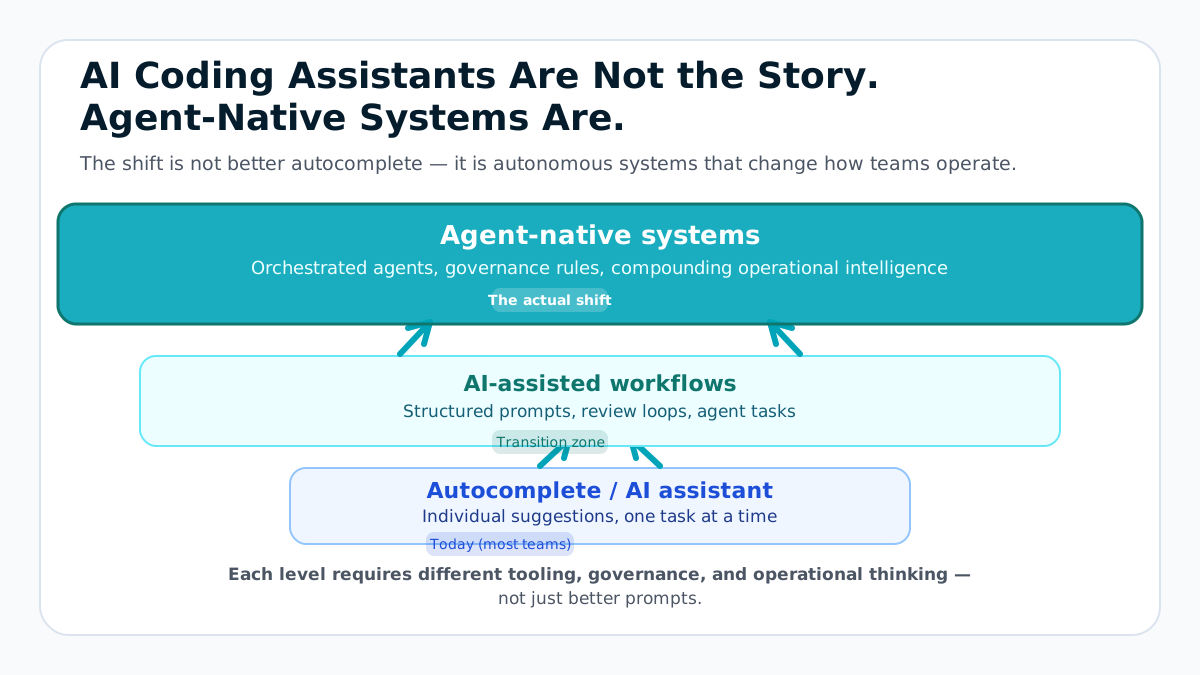
AI Coding Assistants Are Not the Story. Agent-Native Systems Are.
We Are Naming the Wrong Thing
Most of the market is still talking as if the important breakthrough is an AI assistant that helps a developer write code faster.
That framing is already too small.
It encourages people to think in terms of:
- prompts
- autocomplete quality
- faster boilerplate
- nicer chat interfaces
- personal productivity gains
Those things matter. But they are not the deepest shift.
The deeper shift is that software is increasingly no longer produced by a single human moving linearly through a queue. It is produced by a system made up of:
- human judgement
- planning artefacts
- parallel agent execution
- convergence routines
- verification gates
- documentation loops
- and operating rules that determine what the system is allowed to do
That is a different category of thing.
It deserves a different name.
I think the more accurate language is agent-native systems.
Why This Matters
Categories shape behaviour. If you call something an assistant, you optimise for convenience. If you recognise it as a system, you optimise for:
- reliability
- governance
- throughput
- convergence
- quality signal
- organisational leverage
That is a much more serious frame.
The assistant framing keeps the discussion at the surface:
- Which model is best?
- Which IDE integration is nicest?
- Which prompt works well?
The systems framing moves the discussion where it belongs:
- How is work decomposed?
- How do multiple tracks converge?
- What keeps the output coherent?
- How do you stop speed from turning into probabilistic software?
- What decisions should stay human?
- What truths must be documented for the next wave to stay aligned?
That is where the durable advantage lives.
The Real Break Is Organisational, Not Cosmetic
The interesting part is not that an engineer can ask a model to write a function.
The interesting part is that a disciplined human can increasingly direct a system that moves:
- product delivery
- testing and hardening
- architecture clarification
- tooling and governance
- release preparation
- technical documentation
- and supporting business work
in parallel.
That changes the operating envelope of teams. And in some cases, it changes the operating envelope of a team of one.
The practical consequence is easy to understate. You are no longer only improving the efficiency of implementation. You are changing the shape of execution itself.
This Does Not Reduce the Need for Experience
If anything, it raises it.
As implementation gets cheaper, the decisions that matter move up the stack. The costly mistakes become:
- choosing the wrong workstream
- creating unstable interfaces
- shipping weak verification
- widening the promise faster than the evidence
- failing to document the new truth
- generating support complexity faster than the business can absorb it
That is why I do not think this era belongs to whoever can produce the most code-shaped output.
I think it belongs to the engineers, founders, and operators who can build frameworks around agent leverage without losing discipline.
When implementation becomes cheap, bad judgement scales faster. The problem stops being “we cannot build enough” and becomes “we can now build the wrong thing, the wrong way, with frightening efficiency.”
The New Advantage Is Not Prompting. It Is System Design.
The durable advantage is not a secret prompt. It is a system that makes good work easier and drift more expensive.
That usually means:
- clear planning anchors
- stable interfaces
- repeatable patterns
- quality gates with real signal
- explicit decomposition rules
- strong convergence routines
- documentation that is treated as live system memory rather than stale ceremony
The teams that understand this will not think of AI as an add-on feature. They will think of it as a forcing function for redesigning how engineering operates.
The Next Serious Layer: Agent-Native Governance
A lot of companies will stop at AI-assisted output. That will get them some gains.
But the real next layer is governance for agent behaviour:
- what an agent may change
- how plans are written
- what constitutes proof
- which boundaries require stricter review
- how quality failures are caught before merge
- how new system truths are propagated
This is where the next generation of engineering infrastructure will be built. Not just faster models, but systems that allow agentic throughput without losing coherence.
What This Changes for Founders
For founders, this shift is bigger than a productivity upgrade.
It changes:
- what a realistic product scope looks like
- how fast ideas can be tested
- how quickly a launch surface can be prepared
- how many internal functions one person can coordinate
- what the real bottleneck in the business actually is
When implementation compresses, many old excuses stop working. The bottlenecks become:
- judgement
- prioritisation
- activation
- proof
- support
- and distribution
That is not a minor efficiency improvement. That is a change in the operating model of a business.
What This Changes for Engineering Teams
The most serious engineering organisations will not ask only:
- how do we give developers AI tools?
They will ask:
- how do we redesign engineering around parallel agent execution and disciplined convergence?
That means rethinking:
- planning cadence
- documentation standards
- test quality expectations
- interface discipline
- code review patterns
- release management
- and what technical leadership looks like when code is no longer the scarce output it used to be
The Category That Is Emerging
I think three connected categories are starting to emerge:
- Agent-native software development
- Agent-native engineering governance
- Agent-native operating systems for businesses
The first changes how software is built. The second changes how software quality is preserved. The third changes how a company directs the resulting leverage.
That is why I think the future conversation will move beyond “AI coding assistants.” That label is too narrow for what is actually happening.
Related Reading
- I Have Barely Written Code by Hand in Two Years. I Have Never Built More. describes what this systems shift feels like from inside day-to-day engineering work.
- The Operating Envelope of a Solo Engineer Has Changed explores how the same shift changes the leverage of one experienced operator.
- The Hard Part of AI SaaS Isn’t the Agent. It’s the Boundary shows how this wider systems model creates new architectural demands around trust and runtime guarantees.
Final Thought
The big story is not that software engineers now have a better tool.
The big story is that the unit of production is changing from a person working serially to a system that combines human judgement with orchestrated agent execution.
That has consequences far beyond the editor. It changes how software is built, how quality is enforced, how companies operate, and what one capable person can direct.
The teams that treat this as a UX improvement will get incremental gains. The teams that treat it as a systems shift will build a different class of organisation.
That is the real story.